Of all the types of spiders in the Texas Hill Country, Texas A&M AgriLife counts only two kinds as medically significant in Texas: the brown recluse and the widow spiders, which include the black widow. This guide covers those two and four other spiders Texas A&M describes, from the wolf spider that comes in under the door to the tarantulas that cross Texas roads in summer. The chart sorts them from no danger to people to medically significant, and each species below has a drawing, the details that give it away, and what to do.
Quick answer
Texas A&M AgriLife considers only two kinds of spiders in Texas medically significant: the brown recluse and the widow spiders, such as the black widow. The other four in this guide, the wolf spider, the black-and-yellow garden spider, the jumping spider and the Texas brown tarantula, are not. Texas A&M says wolf spiders pose no danger to people or pets and calls garden spiders harmless; jumping spiders and tarantulas can bite if they are handled.
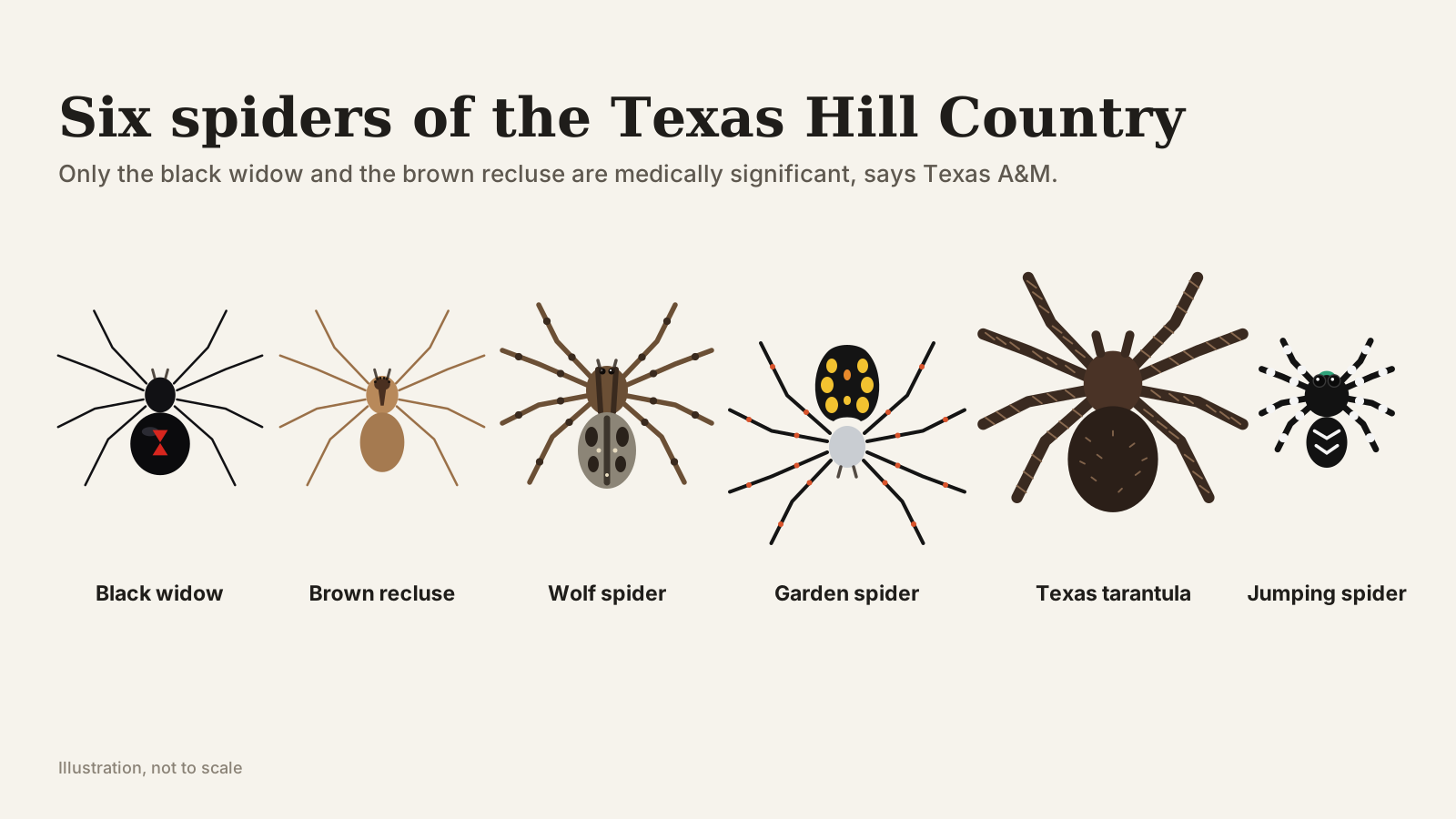
Hill Country spiders, from no danger to people to medically significant
No danger to people
- Black-and-yellow garden spider
- Wolf spider
Bites only if handled
- Jumping spider
- Texas brown tarantula
Medically significant
- Brown recluse
- Black widow
A rough guide drawn from the Texas A&M descriptions below. Texas A&M notes that, with few exceptions, spiders rarely bite and are not generally dangerous to people.
What are you seeing?
- A shiny black spider hanging upside down in a messy web by a meter box, woodpile or garage corner
- Black widow. The red hourglass is on the underside, so look without reaching in.
- A plain brown spider in a closet, attic or stored box
- Possibly a brown recluse. Check for six eyes in three pairs; the violin mark can be faint.
- A big, hairy spider with dark stripes running across the floor at night
- Wolf spider. Stripes, no violin mark, and a large pair of eyes on top of the head.
- A large black-and-yellow spider in the middle of a big web with a white zigzag
- Black-and-yellow garden spider, usually noticed in late summer.
- A stocky, colorful spider that jumps
- Jumping spider.
- A very large, hairy brown spider crossing the yard or the road in summer
- A male Texas tarantula out looking for a mate.
Dealing with this right now?
Black widows by the meter box or brown recluses in the closet? ACI Pest & Lawn will identify what you're seeing and treat where spiders hide, across the Highland Lakes.
See how we handle it on our spiders page.
The six spiders, one by one
Black widow
Medically significant
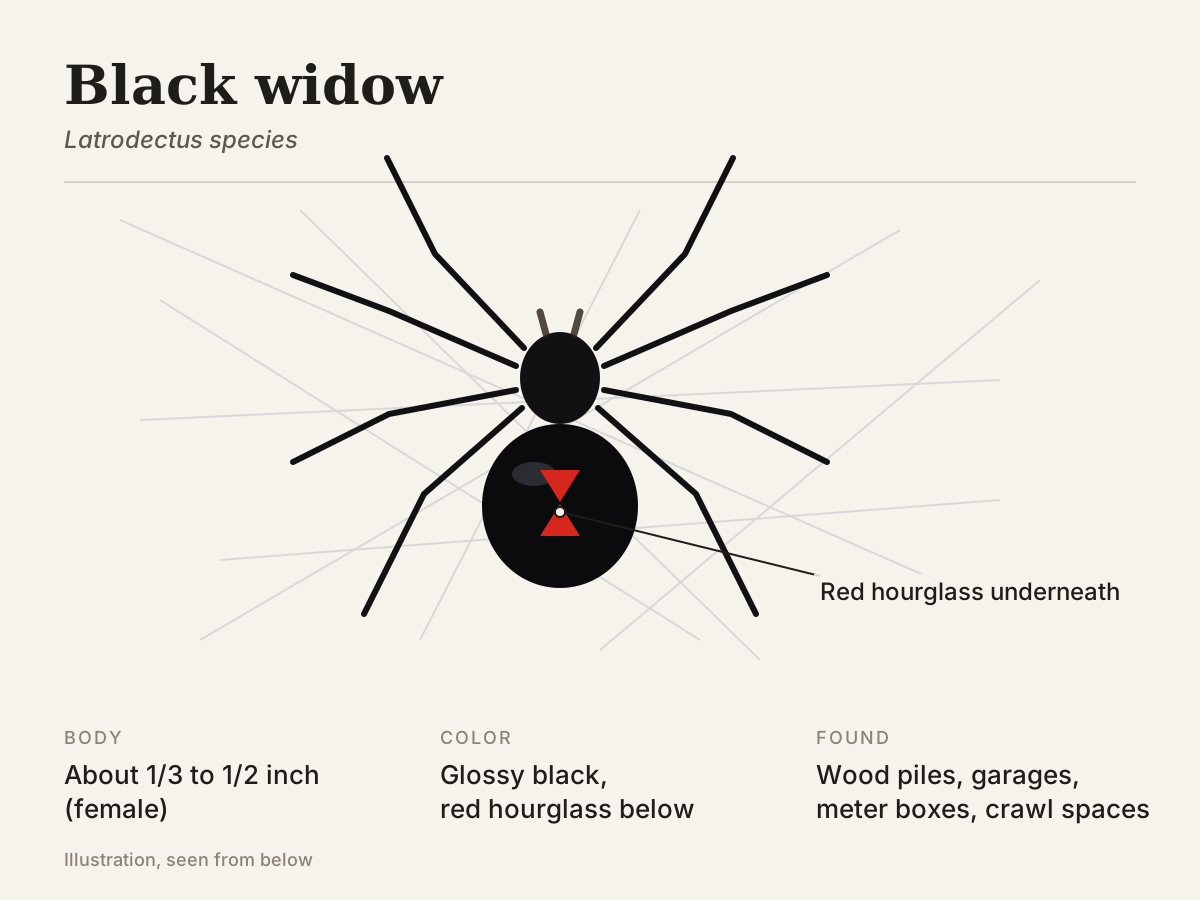
Adult female black widows are typically black, and the underside of the abdomen often has two reddish triangles that form an hourglass. They hang upside down in the web, which puts the hourglass on show. Males and young spiders look different: they can have orange, red and white markings on the back and sides, and adult males are much smaller. Penn State Extension measures the female's body at 8 to 13 millimeters, about a third to half an inch, and 25 to 35 millimeters with the legs spread.
The web is strong, sticky and irregular, nothing like the neat wheel of a garden spider. Texas A&M lists where they turn up around homes: wood piles, garages, cellars, crawl spaces, shrubbery, rain spouts, and gas and electric meters, the protected spots outdoors or in buildings open to the outdoors. They are shy, and Texas A&M says widow spiders most often bite when they are threatened or pressed against the skin.
The bite can feel like a pinprick, if it is noticed at all. Widow venom affects the nervous system: within 1 to 3 hours there can be moderate to intense pain through the body, and other symptoms include tremors, nausea, vomiting, leg cramps, abdominal pain and heavy sweating. Texas A&M notes bites can be more dangerous for children, older adults and people with health problems.
What to do: Texas A&M's advice is to seek medical care for a black widow bite; the patient should be taken to a hospital emergency room for the appropriate antivenom. Wear gloves when reaching into woodpiles or meter boxes, move firewood away from the house, and prune shrubs that touch the walls so widows have fewer places to build. For webs that keep coming back around the foundation, see our spider and pest control.
Brown recluse
Medically significant
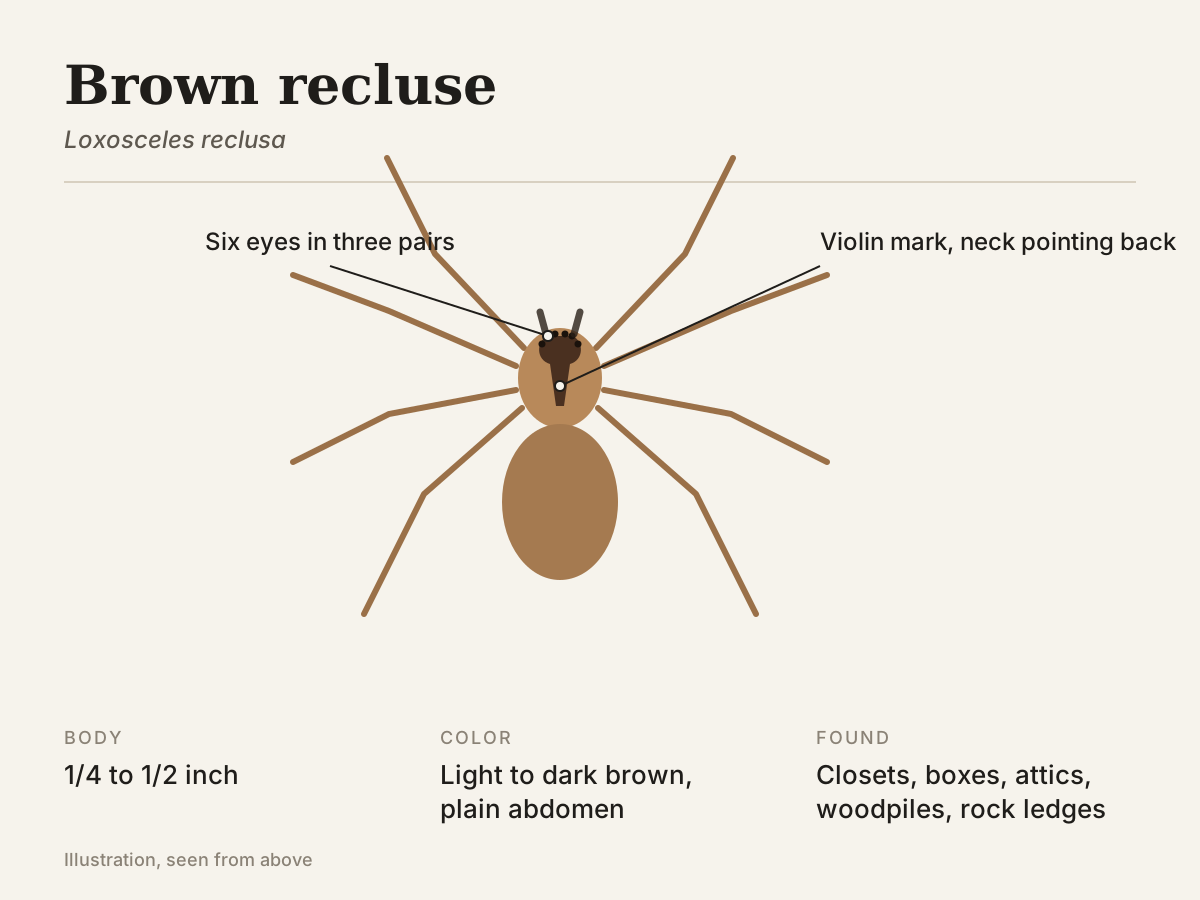
A brown recluse is light to dark brown with long, slender legs that have no spines. Its body is only 1/4 to 1/2 inch long, but walking, body and legs cover about the area of a quarter to a half dollar. It has six eyes arranged in three pairs, and usually a dark, violin-shaped mark on the front body section with the neck of the violin pointing back toward the abdomen. Texas A&M AgriLife Extension specialist Wizzie Brown notes the mark can be faint and look like markings on non-venomous spiders, so size, color and eye pattern are the better tells; only one other spider group in Texas has that eye pattern, and it is not venomous.
Brown recluses are found inside and outside throughout Texas. Outdoors they hide in stacked firewood, under stones and in rock ledges; indoors they live in attics, crawl spaces, closets, stored boxes and behind baseboards. They hunt insects at night and do not use a web to catch prey. Bites are usually accidents: someone rolls onto one in bed or puts on clothes that have hung undisturbed near where it was hiding.
Recluse venom breaks down skin and muscle tissue at the bite. The bite may be painless at first, then become mildly to severely painful 2 to 8 hours later; a blister usually forms about 24 hours after the bite, and a slow-healing sore within a week. AgriLife Today, reporting Texas A&M's guidance, says there has never been a confirmed death attributed to the brown recluse.
What to do: Diagnosis is difficult, so Texas A&M suggests taking the spider to the doctor for identification, and seeking medical attention for any serious reaction or a wound that is not healing properly. At home, shake out clothes that have been in storage, seal stored boxes with tape, and set sticky traps along walls. Texas A&M says infestations are hard to control even for professionals, so ask any company whether it has experience with brown recluses; ours is spider and pest control across the Highland Lakes.
Black widows or brown recluses around the house?
ACI Pest & Lawn treats spiders across the Highland Lakes on its bi-monthly program: a technician inspects every two months, treats where there is activity, and clears accessible webs around doors, lights and porches.
Wolf spider
No danger to people
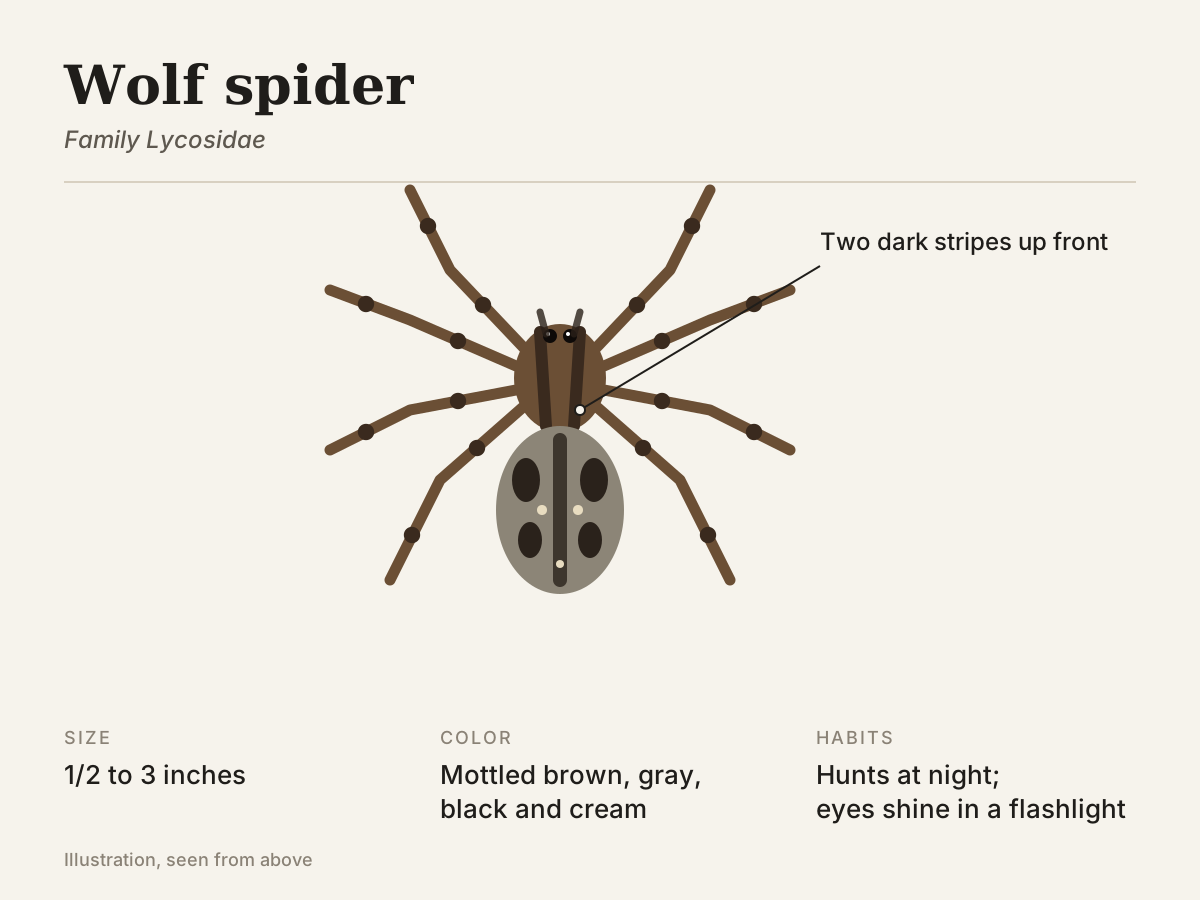
Wolf spiders are hairy, their drab color mottled with brown, gray, black, yellow or creamy white markings, and they often have two dark stripes running lengthwise on the front body section. Texas A&M gives them a range of 1/2 to 3 inches long. They have eight eyes: a front row of four tiny ones in a straight line and a larger pair above.
They are among the most common spiders in fields and backyards, and Texas A&M says hundreds to thousands may live in the average backyard lawn, which is why they so often come in under gaps in doorways. They hunt after dark and have good night vision, and their eyes reflect a flashlight beam, so a light shone into grass at night picks out dozens of tiny points of light. A female carries a round silk egg case and then carries the spiderlings with her until they can hunt on their own.
They are easy to mistake for a brown recluse. The differences: wolf spiders usually have dark stripes on the front body section, no violin mark, and a large pair of eyes on top of the head. Texas A&M says they do not pose any danger to people or pets.
What to do: Slide one onto a sheet of paper and put it outside. Weather stripping around doors and windows keeps more of them out. If they keep coming in, our bi-monthly pest control program has a technician inspect and treat around the house every two months.
Black-and-yellow garden spider
No danger to people
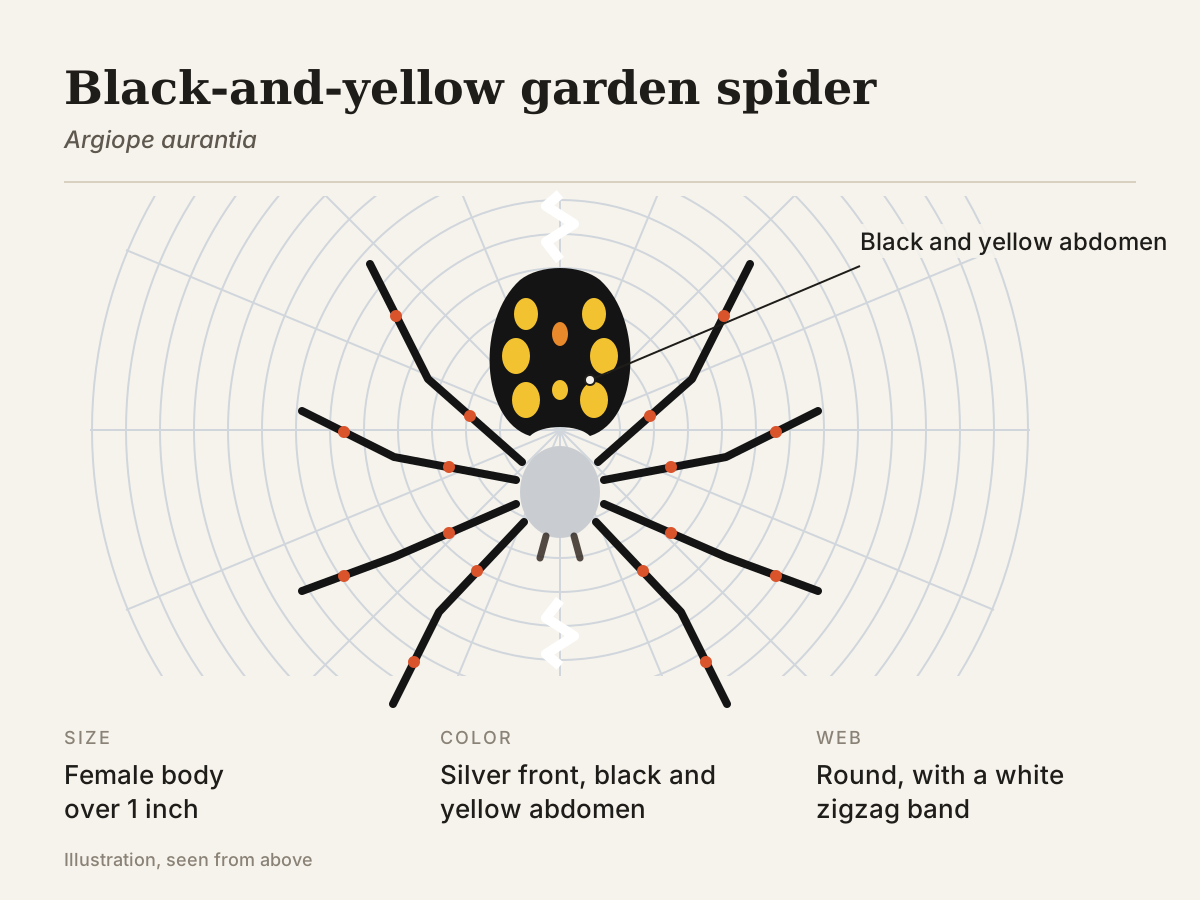
This is the big black-and-yellow spider that hangs head down in the center of its web. Females have a body more than 1 inch long with even longer legs, while males are often under 1/4 inch. The front of the body is covered in silver hairs, the abdomen is marked in black and yellow and sometimes orange, and the legs are black with short bands of orange, yellow or red. It is also called the writing spider.
Its web is a round, vertical orb with rings of sticky silk, often with a white zigzag stripe down the center that Penn State Extension calls the stabilimentum; what it is for is unclear. Webs turn up in fields, on fences and around homes, in sunny spots near flowers, tall plants and shrubs, and many orbweavers tear their webs down and rebuild them every day. The spiders mature in late summer, which is when most people first notice them, and lay round, brown, papery egg sacs then too.
Texas A&M calls them harmless to people, though their webs can be a nuisance when they are built where people walk. Penn State notes people are not likely to be bitten unless they handle a female with an egg sac in the web. They catch and eat insects as big as grasshoppers.
What to do: Leave a web that is not in the way. One across a doorway or a path can be swept down with a broom, and on our bi-monthly program the technician clears accessible webs around entry doors, lights and porch coverings.
Texas brown tarantula
Bites only if handled
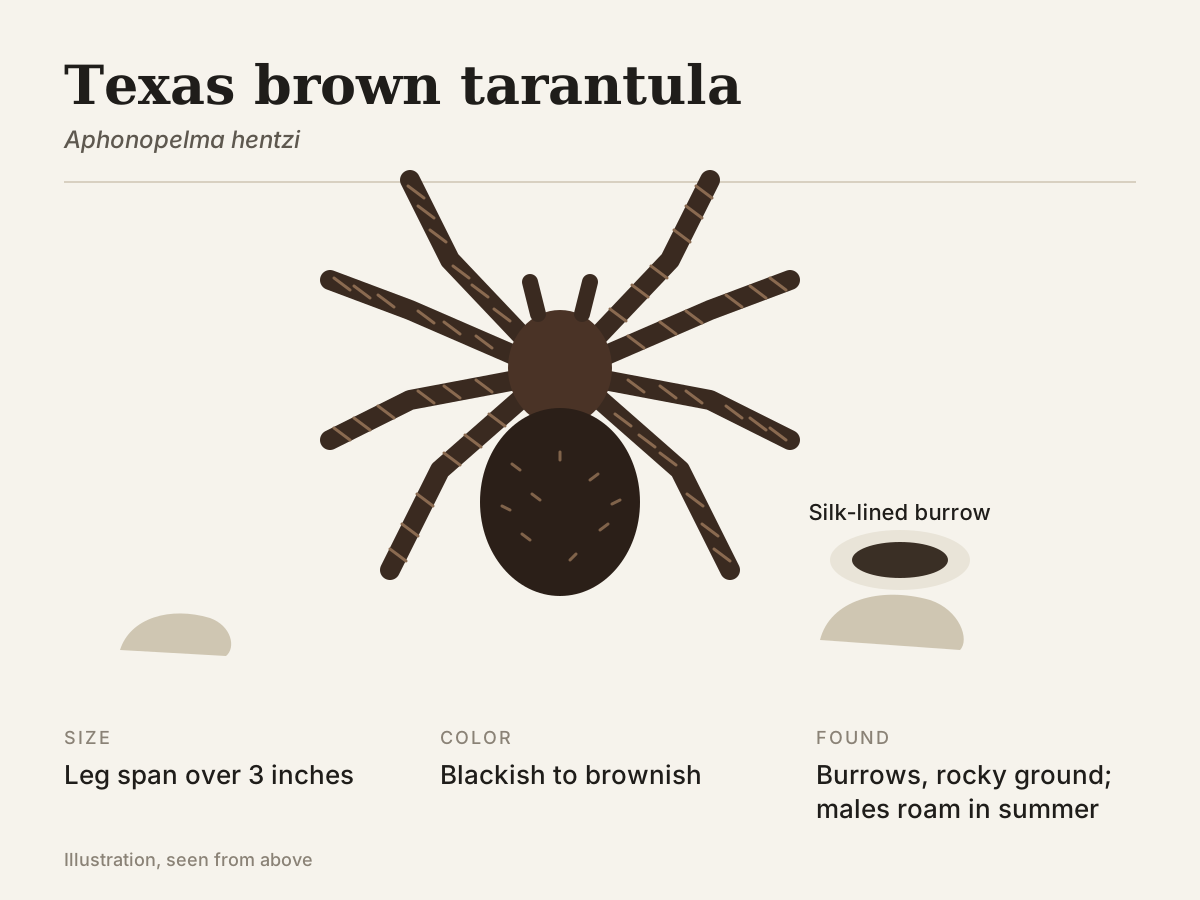
Texas has 15 tarantula species. The common Texas brown tarantula can have a leg span of more than 3 inches when fully grown, and Texas species can reach up to 6 inches from the tips of the front legs to the tips of the back legs. They are blackish to brownish, and darker after they molt. Texas A&M AgriLife says you are more likely to meet one in the rockier areas of Central and Southwest Texas.
They live in burrows in well-drained soil or under rocks and logs, line the burrow with silk, and wait near the entrance for prey to come to them: insects, other spiders, and small lizards, frogs and snakes. The ones you see crossing yards and roads, sometimes by the hundreds along Texas highways, are males out looking for females, mostly between May and August. Females stay in their burrows.
Tarantulas are shy. They are not venomous to humans, but they can bite, and Texas A&M compares the bite to a bee sting. They usually warn first by rearing up on their back legs or showing their fangs, and they can flick hairs off the abdomen that irritate the skin, eyes and nose.
What to do: Admire one and leave it alone; don't handle a wild tarantula. Door seals are usually enough to keep them out of the house, and if one does get in, cover it with a glass, slide paper underneath and carry it outside. Texas A&M's Travis County office notes they really are not a pest and don't warrant control.
Jumping spider
Bites only if handled
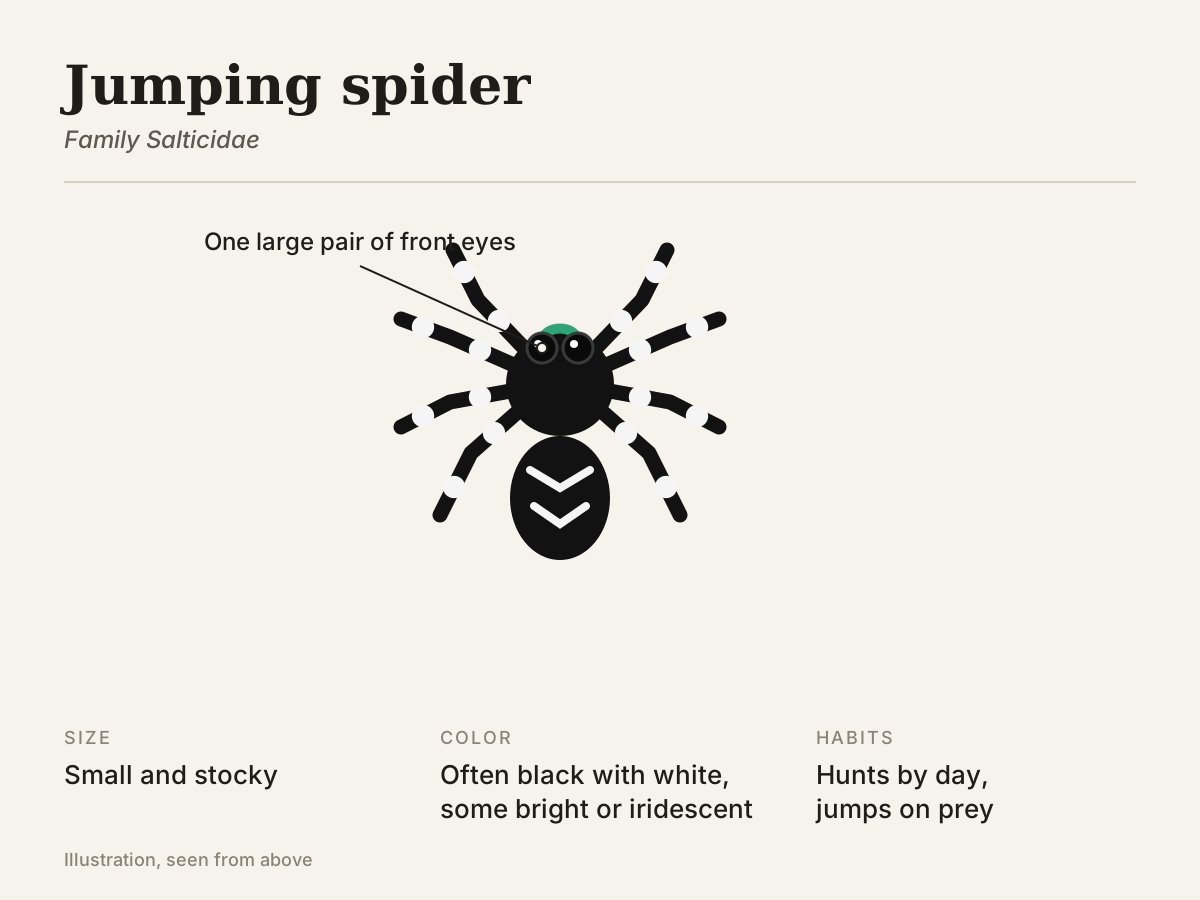
Jumping spiders tend to be stocky and brightly colored. Some have bold black and white bands on the body or legs, and the colors run from browns, grays and black to brilliant red, yellow and metallic or iridescent greens. Males are especially ornate and use their colors and mating dances to attract females. They have eight eyes, including one large pair in front.
They are territorial, hunt during the day and, as the name says, are excellent jumpers. Each leap trails a line of silk, so after a missed jump you may see one dangling from its thread.
Texas A&M says jumping spiders are unlikely to bite unless cornered or handled.
What to do: Leave it be outdoors, or move one from inside by covering it with a cup and sliding a sheet of paper underneath. If you are seeing spiders of every kind indoors, start with the steps below and then see general pest control.
Keeping spiders out of the house
Texas A&M AgriLife's starting point is that spiders are largely beneficial: they help keep flies and plant-feeding insects under control. The goal is to keep them outside and give them fewer places to hide indoors. Its recommendations:
- Install or repair weather stripping around doors and windows.
- Outdoor lights draw insects and the spiders that feed on them. Use yellow bug lights, point lights away from doorways and turn them off when they are not needed.
- Move firewood and building materials away from the house, and prune shrubs and trees that touch it, which discourages widow spiders from building webs on the outside walls.
- Store things in plastic containers with tight-fitting lids, or seal cardboard boxes with wide tape on every seam.
- Use a hand vacuum to remove spiders, their webs and their egg cases.
- Wear cotton or leather gloves when working in woodpiles, sheds and other spots spiders favor.
When to call for help
Texas A&M notes that spiders are usually difficult to kill with insecticides, and that because they can be difficult to control, it may be best to hire a pest management professional. For brown recluses in particular, it suggests asking any company you are considering whether it has experience with them.
ACI Pest & Lawn handles spiders on its bi-monthly pest control program across Marble Falls, Kingsland and the rest of the Highland Lakes. For more on the two that matter most, read black widows and brown recluses in Marble Falls. Not sure what you found? Contact us and we'll identify it.
Related
Sources
- Texas A&M AgriLife Extension: Spiders in Texas: Types, Benefits and Safety Tips (ENTO-PU-041, Wizzie Brown and Mike Merchant, 2022)
- Texas A&M Urban and Structural Entomology: Black widow spider
- Texas A&M Urban and Structural Entomology: Brown recluse
- Texas A&M Urban and Structural Entomology: Wolf spider
- Texas A&M Urban and Structural Entomology: Yellow garden spider
- Texas A&M AgriLife Extension: Control of brown recluse spiders (ENT-3003)
- AgriLife Today: Brown recluse spider: Fact vs. fiction and tips for prevention (2023)
- Texas A&M AgriLife Extension: Texas tarantula tango: understanding their annual hunt for food, love (2024)
- Texas A&M AgriLife Extension, Travis County: Texas tarantulas, by Wizzie Brown (2023)
- Penn State Extension: Southern black widow spider
- Penn State Extension: Yellow garden spider
- University of Florida Entomology and Nematology: Yellow garden spider, Argiope aurantia
- Kansas State University Extension Entomology: Golden garden spider (2020)